Sunday, March 29, 2009

35,000 protesters, police arrest just one !

35,000 protesters turn out for G20 march in London ... but police arrest just one
By Daily Mail Reporter

A demonstration by more than 35,000 protesters marching for 'jobs, justice and climate' ahead of the G20 summit passed off peacefully in London today.

But there are fears that trouble could flare when further protests take place as world leaders gather in the capital next week.

Thousands of police from six forces were drafted in to London today to assist the Metropolitan Police.

g20 protests London

The Met police line a pavement in Whitehall, as they observe secure a protest march

G20 protests London

Protesters were calling for action on poverty, climate change and jobs ahead of next week's G20 summit in the Docklands.

But they kept a relatively low profile as campaigners from across the UK and around the world braved rain showers to take part in the first of a week of demonstrations around the G20 summit.

The massive police operation was launched as officers warned of an "unprecedented" threat posed by the protests.

But by early evening as a rally in Hyde park ended there were no signs of problems, backing up the organisers' earlier pledge that events would not turn violent.

'Natural' breast enlargement

'Natural' breast enlargement using stem cells from spare fat to be made available in Britain

By Daniel Martin

breasts

'Natural' breast enlargement through stem cell therapy is said to be an improvement on implants

A new stem cell technique to enlarge the size of a woman's breasts while reducing the size of her waistline is to made available in Britain for the first time.

The revolutionary new treatment involves taking stem cells from spare fat on the stomach or the thigh, and then growing them in a woman's breasts.

Surgeons say the result gives a more natural look than many of the synthetic implants used by showbusiness stars like Pamela Anderson.

But the stem cell process can only create an increase of one cup size, although supporters expect bigger breasts later as the technique improves.

Around a dozen British women have already had their breasts repaired with stem cells after having cancerous cells removed. But this is the first time the process will be used on healthy women.

Professor Kefah Mokbel, a consultant breast surgeon at the London Breast Institute at the Princess Grace hospital, will treat 10 patients from May.

By the end of the year, he says private patients will be able to pay for the procedure, which he expects to cost around £6,500.

He said stem cell treatment would produce more natural looking breasts than silicone implants.

'This is a very exciting advance in breast surgery,' he said. 'Breasts treated with stem cells feel more natural because this tissue has the same softness as the rest of the breast..

'Implants are a foreign body. They are associated with long-term complications and require replacement. They can also leak and cause scarring.'

Stem cells are primitive cells which have the power to turn into any tissue of the body - organs, skin and blood.

However, although the new technique will increase volume, it will not provide firmness and uplift. For this reason, only modest augmentations are possible at present, although Professor Mokbel plans to carry out research to see if bigger enlargements are possible.

'We are optimistic we can easily achieve an increase of one cup size,' he said. 'We cannot say yet if we can achieve more. That may depend on the stem cells we can harvest.'

Under the special new technique developed in Japan, surgeons will extract spare fat from a woman's thighs or stomach, from which they will extract some stem cells.

These cells will be mixed with another batch of fat before being injected into the breast. It will then take a few months before the breast achieves its desired shape.

Surgeons have tried injecting plain fat into breasts before in a bid to increase size, but have found it difficult to maintain a blood supply to the new tissue. Stem cells however encourage the growth of blood vessels to ensure a sufficient supply is maintained.

The technique has been available in Japan for six years. Professor Mokbel says that after carrying out about 30 procedures, he should be able to offer the procedure to private patients.

Some experts warn that stem cells should not be used in healthy women until large-scale trials in cancer patients have shown that the new policy is safe.

Eva Weiler-Mithoff, a consultant plastic surgeon at Canniesburn hospital in Glasgow, has treated at more than 10 British cancer patients with the technique and says it should not be extended to healthy women.

She said that while breast cancer patients regularly attend follow-up appointments, young women who have had cosmetic surgery are less likely to do so - meaning complications could be missed.

EARTH HOUR

The landmark St. Stephens tower of the Houses of Parliament in central London

March 29, 2009

Earth Hour

As 8.30pm struck in each timezone, 4,000 cities and towns in 88 countries switched off the lights to symbolise the threat of climate change. The St Stephens tower at the Houses of Parliament, home to Big Ben, joined the big switch-off

(Lefteris Pitarakis/AP)

The Sydney Opera House

The global event began in Australia in 2007, when 2.2 million people switched off their lights and the Sydney Opera House was plunged into darkness

(Krystle Wright/AFP/Getty Images)

A night view of the site of the ancient Giza Pyramids

Last year the movement grew to 400 cities and this year it has spread to 3,929 cities and villages and historic sites such as the Giza Pyramids

(Nasser Nouri/AP)

The Taj Mahal hotel in Mumbai, India

Earth Hour

The Taj Mahal hotel in Mumbai, India

(Arko Datta/Reuters)


Malaysias Petronas Towers and Kuala Lumpur Tower during Earth Hour

(reuters)

Malaysia's Kuala Lumpur Tower (L) and Petronas Towers (R)

The Eiffel Tower at Earth Hour

(reuters)

The Eiffel Tower at 8.30

The goal is to get an ambitions deal to curb emissions of heat-trapping gases that scientists say are dangerously warming the planet.

Friday, March 27, 2009

News In Picture


Musudan Ri, North Korea, formally know as Taepo-dong missile launch facility, the area where North Korea rocket launch facility is located is seen in this satellite image by DigitalGlobe taken on March 23, 2009. North Korea has positioned what is believed to be a long-range ballistic missile on a launch pad in what could be a preparation for launch, a U.S. counterproliferation official said March 25, 2009. MANDATORY CREDIT REUTERS/DigitalGlobe/Handout


A rescuer searches for flood victims on the outskirts of Jakarta March 27, 2009. A dam on the outskirts of the Indonesian capital burst on Friday, killing 28 people and flooding hundreds of houses nearby, officials said. REUTERS/Dadang Tri

At least 52 killed after Indonesia dam bursts

China aviation giant spins off branch: report

VINCE McMAHON... trying to halt death toll

Vince makes rehab offer to 535 wrestlers
VINCE McMAHON ... trying to halt death toll

VINCE McMAHON ... trying to halt death toll

WWE boss Vince McMahon has revealed just how far the company are going in a bid to stop any more wrestling deaths.

Vince has made public a letter he has sent to 535 former WWE grapplers offering to pay for rehab, regardless of how long they worked for him or why they left.

He says he is doing this to prevent any future tragedies, in the wake of the passing of superstars including British Bulldog Davey Boy Smith, Eddie Guerrero and most recently Andrew ‘Test’ Martin.

Vince writes: “Over the last 10 years, an inordinate number of wrestlers have passed away.

“Some of those deaths may, in part, have been caused by drugs and alcohol.

“In an effort to help prevent such tragedies in the future, the WWE is offering to pay for drug and/or alcohol rehabilitation at a certified treatment center chosen by the WWE for any performer with a prior WWE booking contract who may need this service.

"WWE will pay for this service in full – there is no cost to you or your family.

“Help will be provided regardless of the circumstances of your departure from the WWE or the amount of time you performed for WWE.”

The offer was first made to former stars in September 2007. In that time 3.1 per cent have accepted it, including Test who underwent rehab last year.

Vince concludes the letter by saying: “Please reach out if you think you might have a drug and/or alcohol problem, or if you know someone who does.

“We all need to do everything we can to help prevent another tragedy.”

John Cena

Meanwhile, John Cena has once again confirmed his belief that anyone taking steroids should be sent to jail.

Cena – who first aired this view in a Sun WrestleCast – was asked by a New York paper about his views on baseball legend Alex Rodriguez using them.

He replied: “The government should take the initiative, and if you get caught using drugs, then you should go to jail.

“A criminal record will hurt your endorsements and long-term contracts.”

Cena added: “Steroids are the personal choice of the athlete.

“If there was a set of legal stipulations set in place, he may never have even considered it.”

April 1... Virus Alert!

Will your PC be hijacked on April 1?

Threat ... is virus hoax?

Threat ... is virus hoax?

By DAVE MASTERS

MILLIONS of computers around the world could go into meltdown on April 1 because of a deadly virus.

The Windows worm called Conficker could give a hacker unrestricted access to every infected machine on the planet.

And the aggressive bug could be hiding on your PC at home right now, waiting to kick in.

For the hackers, it’s like having a virtual army at their fingertips.

The criminals behind it have the power to launch a tidal wave of junk emails, bringing computers grinding to a halt.

They could also plunder information, including your bank details.

But the truth is that the best techie brains in the business just don’t know exactly what the hackers have in mind.

Infected

Virus expert Mikko Hypponen, from the firm F-Secure, said: “It is scary thinking about how much control a hacker could have over all these computers. They would have access to millions of machines.”

Microsoft, who developed the Windows computer operating system, have slapped a £175,000 bounty on whoever is responsible, so far without success.

The sophisticated Conficker bug — also known as Downadup or Kido — targets systems via the web and can be spread on memory sticks.

More than nine million computers were infected at the bug’s peak last month.

And if Conficker is still on your system come Wednesday, you could be in trouble.

Once inside your PC, it sets up files and starts downloading information from a controlling “boss” server.

Finding that website and the mastermind behind it all is like looking for a needle in a haystack.

That is because the bug creates hundreds of bogus addresses every day to put investigators off the scent.

The infected PCs then form a network and “talk” to each other, updating and evolving.

The bug even attacks anti-virus software and other files on your computer to strengthen its position.

And it resets “restore” points, making recovery of your old system even harder.

The first of three Conficker strains was discovered in November last year.

A second, more aggressive strain followed in December and a third this month. This contains the all- important April 1 trigger.

Trigger

To avoid infection, Windows users must download a special free update “patch” from the Microsoft website. But that isn’t enough — you also need good anti-virus software too.

Many businesses around the world are thought also to be at risk after failing to update systems.

Graham Cluley, from computer security firm Sophos, warned: “Microsoft did a good job of updating people’s home computers.

“But the virus continues to infect businesses that have ignored the update.”

He also stressed the need for strong passwords on your computer, adding: “If users are using weak passwords — 12345, QWERTY etc — then the virus can crack them.”

F-Secure’s Mikko warned potential problems with Conficker would be highlighted wildly before April 1.

But he said he didn’t foresee an attack, despite the fears and mystery surrounding the problem.

He said: “There’s always hype — just think of previous cases.

“There is not going to be a ‘global virus attack’. We don’t know what they are planning to do, if anything.

“I think the machines that are already infected might do something new on April 1.”

Let’s hope, for everyone’s sake, that it turns out to be an April Fools’ Day hoax.

TEST your system’s safety for free by attempting to go to f-secure.com. If you can’t, you can download the patch at microsoft.com to disinfect your PC.

Mexico's drug war

In December of 2006, Mexico's new President Felipe Calderón declared war on the drug cartels, reversing earlier government passiveness. Since then, the government has made some gains, but at a heavy price - gun battles, assasinations, kidnappings, fights between rival cartels, and reprisals have resulted in over 9,500 deaths since December 2006 - over 5,300 killed last year alone. President Barack Obama recently announced extra agents were being deployed to the border and Secretary of State Hillary Clinton heads to Mexico today to pursue a broad diplomatic agenda - overshadowed now by spiraling drug violence and fears of greater cross-border spillover. Officials on both sides of the border are committed to stopping the violence, and stemming the flow of drugs heading north and guns and cash heading south.

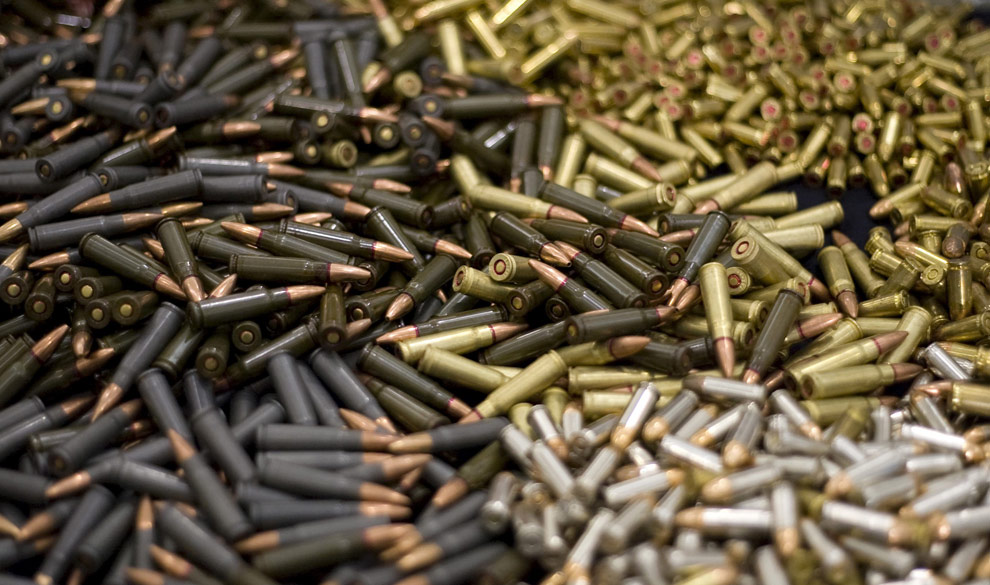
Seized ammunition is shown during a presentation of suspected members of the Pacifico drug cartel in Mexico city's airport on March 12, 2009. (REUTERS/Jorge Dan Lopez)

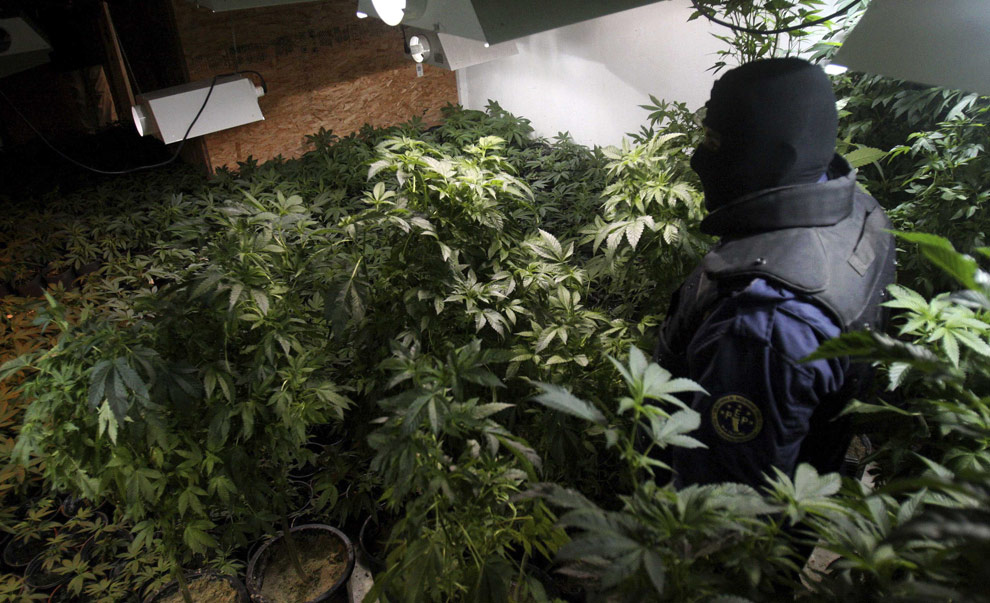
Baja California state police stand guard at a captured marijuana greenhouse in the basement of a ranch in Tecate, Mexico on March 12, 2009. (REUTERS/Jorge Duenes)

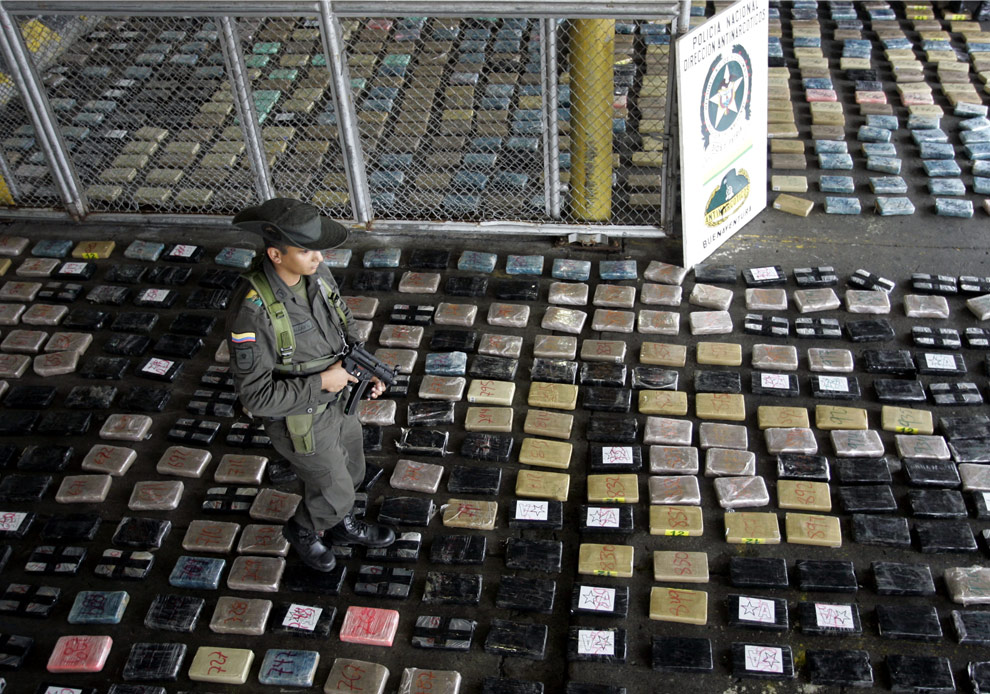
A police officer walks on packages of cocaine in Buenaventura, Colombia's main seaport on the Pacific coast, Monday, March 23, 2009. Colombian police had seized 3.5 tons of cocaine in a container of vegetable grease bound for Mexico. (AP Photo/Fernando Vergara)

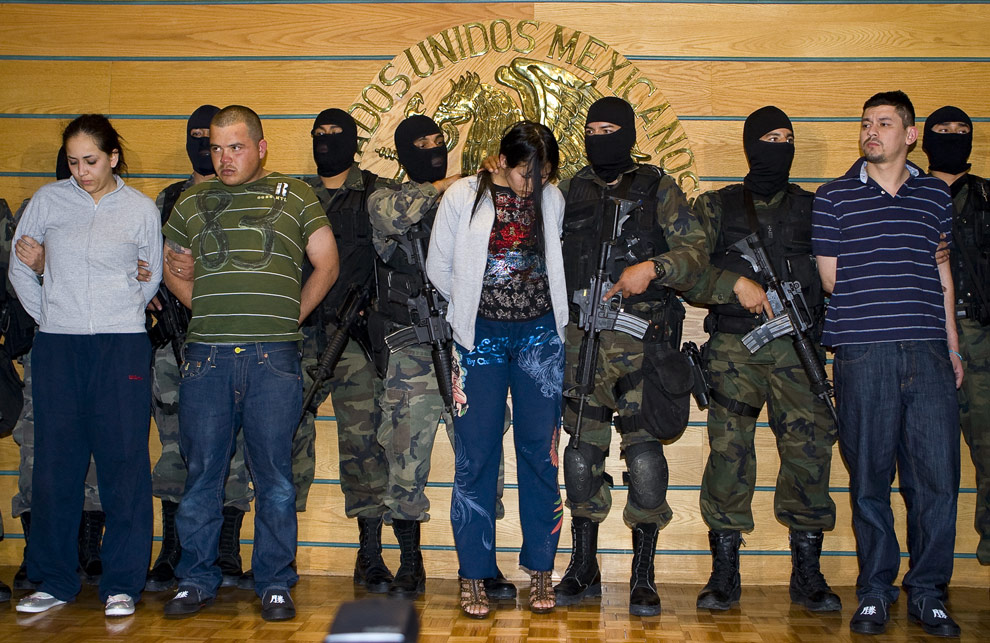
Yaneth Deyinara Garcia (center) and Sigifrido Najera (2nd from left), members of the drug Organization "Cardenas Guillen", are presented to the press at the headquarters of the Defense Secretary in Mexico City on March 20, 2009. (LUIS ACOSTA/AFP/Getty Images)


Army soldiers guard a police station in the border city of Ciudad Juarez, Mexico, Monday, March 16, 2009. As retired and active-duty soldiers largely took over security in the violence-wracked city of 1.3 million, a retired Army officer took over as head of police Monday, whose previous law enforcement chief resigned earlier, after receiving threats. (AP Photo)

Federal police officers sit aboard an aircraft while flying to the border city Ciudad Juarez in Mexico, Monday, March 2, 2009. The deployment is part of a troop increase of 5,000 men planned for this city which has been hit hard by organized crime related violence. (AP Photo/Miguel Tovar)

A member of the Army watches the incineration of fourteen tons of drugs in Ciudad Juarez, Mexico on December 2, 2008. (J. Guadalupe PEREZ/AFP/Getty Images)

Police officers drive past a burning police vehicle in Zihuatanejo, Mexico, Wednesday, Feb. 25, 2009. Earlier, gunmen opened fire and hurled grenades at the patrol car in the Pacific resort town of Zihuatanejo, killing four officers. (AP Photo/Felipe Salinas)

Federal police patrol the border city of Ciudad Juarez March 2, 2009. Hundreds of heavily armed soldiers and convoys of federal police patrolled Ciudad Juarez on Monday amid a massive troop build up to try to restore order in Mexico's most violent city. (REUTERS/Tomas Bravo)

A federal policeman stands guard during an operation at a nightclub in downtown Ciudad Juarez March 7, 2009. Across the border from El Paso, Texas, Ciudad Juarez recently received hundreds of heavily armed federal forces to take over anti-drug efforts from police tainted by corruption and links to drug traffickers. Picture taken March 7. (REUTERS/Tomas Bravo)

Soldiers patrol near the town of Miguel Aleman, on Mexico's northeastern border with U.S., Thursday, March 19, 2009. (AP Photo/Alexandre Meneghini)

Shoes used for smuggling marijuana are displayed in the Drug Museum at the headquarters of the Mexican Ministry of Defense in Mexico City March 9, 2009. High precision rifles, a diamond and gold encrusted mobile phone, clandestine laboratories for drug processing and many more items that once belonged to drug traffickers are displayed in this private museum used by the military to show the soldiers the lifestyle of the Mexican drug lords. (REUTERS/Jorge Dan Lopez)

Texas Armoring Corp. President and CEO Trent Kimball examines a bullet proof windshield after it was shot at their facility in San Antonio, Thursday, Feb. 26, 2009. Due to increased drug-cartel violence in northern Mexico, American companies say they're seeing increases in the number of cars they're asked to outfit with armor plating, bulletproof glass and defensive gadgets like push-button smoke screens and electrified door handles. (AP Photo/Eric Gay)

With a .50-caliber rifle in the foreground, the U.S. House National Security and Foreign Affairs subcommittee holds a hearing on U.S.-Mexico border violence, Thursday, March 12, 2009, on Capitol Hill in Washington, D.C.. (AP Photo/Alex Brandon)

Soldiers escort drug kingpin Hector Huerta Rios at the air force base in Salinas Victoria, on the outskirts of Monterrey, northern Mexico March 24, 2009. Soldiers on Tuesday captured Huerta Rios of the Beltran Leyva cartel who is accused of the killing of a police chief in this industrial city. Huerta Rios was seized along with five persons, weapons and money at his car dealership. (REUTERS/Tomas Bravo)