Monday, March 14, 2011

Japan Hell on Earth

Hell on Earth: I've seen 20 wars. But nothing prepared me for this

By Alex Thomson
Last updated at 12:24 AM on 14th March 2011


The first thing you notice is the silence which seems to hang over the place. There is no sound as we approach this once-thriving coastal town.
Driving round the final bend in the mountain road before making the descent into Minami Sanriku, nothing can quite prepare you for the sight of such destruction.
In my 30 years as a war correspondent I have covered more than 20 conflicts and several major earthquakes, but I have never seen anything on this scale.
There is nothing left: A woman surveys the ravaged town of Minami Sanriku
One minute you are passing through towns and villages completely untouched by natural disaster – not even a pane missing from the windows – and then as you turn the corner it hits you.
The wasteland: A few shattered buildings that survived the might of the tsunami stand sentinel over Miami Sanriku, where the devastation stretches as far as the eye can see
The most astonishing view stretches out below towards the sea for at least four miles. An entire town of around 17,000 people has simply ceased to exist here.
At least 95 per cent of the buildings are not merely ruined; they have been reduced to a morass of splintered wood, jagged concrete and twisted metal. All of this is hideously decorated with the details of destroyed family lives: a woman smiles up from her wedding photographs, a smashed guitar lies in the debris. I see a broken doll, and pages from a child’s school exercise book.
The police try to prevent us going any further, but we get out of our vehicle and walk on. All I can see is mile upon winding mile of a town totally pulverised.
 
An articulated lorry has been concertinaed by the force of the water, the cab ripped off. Four cars have smashed into it and the roof of a house sits on top. Homes have been reduced to matchsticks and driftwood. On the road that leads up to the school, I see another four or five cars hanging perilously over the edge of the hill.
The scene is reminiscent of the photographs of Nagasaki or Hiroshima after the A bombs were dropped during the Second World War. The occasional concrete structure has survived, but nothing else.
This should have been a busy Sunday lunchtime with day trippers and local people enjoying this prosperous, beautiful area with its stunning beaches and wooded areas.
Instead there are small knots of people all across the flattened area, quietly searching for victims or returning to what remains of their homes, searching for possessions they had no time to save.
There is no crying, no hysteria, no anger. It is in the psyche of the Japanese people to do what they have to do in silence and with dignity.
The tidal wave water has receded, but the town’s river is spilling all over the place because the force of the tsunami realigned its banks. There are large stagnant pools of seawater, and mud everywhere.
As we look on, rescuers gently retrieve another body, cradled in a filthy blanket – all they had to hand. The love, respect and ceremony with which these people wrap their dead – people they knew – is perhaps more touching than any tears.
The body will be taken up the hill to the town’s secondary school and join the others in the college gymnasium, now a mortuary.
Ten thousand people are believed to be missing, but as yet there is no way of knowing if they are dead or by some miracle managed to escape before the tsunami struck.
At the school I meet one of the town’s restaurant owners, Yuchida Takuma. He is helping in the mortuary, delicately tying the bright blue polythene body bags which lie in rows.
Rescue mission: Japanese fire department personnel gently lift a barely conscious woman from the wreckage

THE DISASTER AT A GLANCE

1,600 confirmed dead, with fears the final toll could run into the tens of thousands.
Scientists battling to avert a meltdown at Fukushima nuclear plant by pumping in seawater.
Dangerous failures  reported at two other nuclear plants.
100,000 soldiers sent in by the government to help in rescue efforts.
10,000 residents – more than half the population – feared dead in port town of Minami Sanriku.
More than 4,000 calls about missing Britons fielded by Foreign Office.
Geological experts warn of further aftershocks of magnitude 6 and above.
‘I am lucky to be alive,’ he tells me. ‘We heard the sirens – the tsunami warning – and drove up the hill to the school, to high ground. The sirens saved my life.’
I ask him what is left of his restaurant down in the town. ‘Oh,’ he says, bravely managing a smile. ‘There is nothing left at all. It is finished, washed away like everything else.’
Outside on the college baseball ground, a Japanese Army Chinook lands to unload supplies of food and desperately-needed blankets – the nights here are sub-zero. On the roof of the high school building the letters SOS are written bold, for the chopper to land.
Across the way in the college reception, we meet English teacher Shinji Saki. ‘I saw it all,’ he says. ‘The whole thing. First there was the quake, the shaking. Then, the sirens warning there would be a tsunami.
‘I was already here, teaching, up on the hill. But in a few minutes you heard this huge roar and then it all began. We watched as our entire town was simply swept away. It no longer exists.’
I look at him, wondering how it must have felt for those gathered on the hill on Friday watching their friends, family, businesses, being washed away before their eyes.
‘There were around 7,000 of us on the hill that day,’ Shinji says. ‘Perhaps a few thousand at the school on the hill opposite. But there are 17,000 in the town. All the others have gone.’ He shrugs: ‘Who knows if there are eight or ten thousand people still missing here. I just can’t comprehend it.’
We are about to walk away when he opens up about the horrors he has just witnessed. ‘You see, there was this man. I saw him going past on the water, sitting on the roof of his house as it floated by. I saw him. I looked at him and there was nothing at all I could do.’
Nowhere to run, nowhere to hide: A mighty wave of foaming black waterbursts through an embankment in Miyako, crushing cars parked in the street and obliterating everything in its path
Broken home People walk through the debris of what was once a suburb of Minamisanriku in Miyagi Prefecture which was hardest hit by Friday's earthquake and tsunami
All the schools were full the Friday afternoon the tsunami struck. The buildings are all on high ground, so there are many children who have lost their parents.
Everybody here, absolutely everybody, has lost relatives. People are living in the school now, sitting quietly in rows in the classrooms and gymnasiums, with their blankets. Anyone who needs medical treatment has been flown out by helicopter as there is no hospital left in the town.
Blown away: Local residents walk past debris, including an overturned fishing boat, in Minami Sanriku
We leave at dusk, trudging back through mile after mile of utter destruction.
Overhead, the buzzards circle, for there is carrion to be had here. Countless bodies have yet to be retrieved from what remains of this town, wiped from the map in a few moments of thunderous horror.
Life goes on: A woman looks at a picture as she stands on rubble
Homeless: An elderly man looks for his house through the rubble in Rikuzentakata, Iwate Prefecture
Nowhere to go: A woman stops to study a framed picture found amongst a mountain of rubbish in Ofunato City, Iwate Prefecture, while a dazed man (right) searches for his home in the neighbouring town of Rikuzentakata
Lucky to be alive: Victims are given first aid at a Red Cross hospital in Ishinomaki after being evacuated to safety
Close to the edge: A patient in a wheelchair is helped by attendants as they evacuate from a tsunami-affected hospital at Otsuchi

Tuesday, March 8, 2011

Spider venom new Viagra

Spider venom that causes four-hour long erections 'could be the new Viagra'

By Daily Mail Reporter
Last updated at 2:08 PM on 7th March 2011

Most people who find a spider in their bedroom quickly try to get rid of it.
But new research shows that one arachnid might actually be best kept by your bedside.
A single bite from the Brazilian wandering spider has been shown to have side-effects including four-hour long erections.
Unusual side-effects: A single bite from the Brazilian wandering spider has been shown to cause four-hour long erections
The eight-legged creature - also known as the armed spider, banana spider or Phoneutria nigriventer - is native to South and Central America.
Scientists at the Medical College of Georgia believe the species contains a possible breakthrough for erectile dysfunction.
 
Dr Kenia Nunes, a physiologist at the college, said: ‘The venom of the Phoneutria nigriventer spider is a very rich mixture of several molecules.
‘These molecules are called toxins, and then we have various toxins in this venom with different activity.
‘Because of this, when a human is bitten by this spider, we can observe many different symptoms including priapism, a condition in which the penis is continually erect.'
Other side-effects on top of the long-painful erections include loss of muscle control, severe pain, difficulty breathing and if its victim is not treated with anti-venom, could lead to death due to oxygen deprivation.
But its unusual effects could be used to treat sexual dysfunction in both men and women, according to Dr. Nunes.
The new Viagra? The Brazilian wandering spider's venom might lead to a breakthrough new treatment for erectile dysfunction
In her study published in the Journal of Sexual Medicine, Dr. Nunes’ experiment managed to give erection-challenged rats with high blood pressure a bit of a boost.
A peptide called PnTx2-6 was given to the flaccid rats, who achieved side-effect free erections.
Dr. Nunes said: ‘We found the toxin responsible [for the erections] and performed experiments using hypertensive rats which have severe erectile dysfunction. The toxin was able to normalise the erectile dysfunction in these animals.’
The spider’s toxin worked in a different way to drugs such as Viagra though and Nunes told MSNBC: ‘This is good because we know that some patients don’t respond to the conventional therapy.
‘This could be an optional treatment for them.’
She is also hopeful that the toxin could help female sexual dysfunction, but has not yet studied this.
The Brazilian wandering spider, which has a leg span of over four inches, has already been found in some American and Canadian supermarkets but is normally found in tropical banana plantations.
According to the curator of arachnids at the University of Washington’s Burke Museum, Rod Crawford, only 10 humans out of 7,000 have died from its bite.

Tuesday, March 1, 2011

Virtual Jump!

Troops set to take virtual plunge: MoD launches £500,000 parachute jump simulator

By Daily Mail Reporter
Last updated at 6:29 PM on 28th February 2011

State-of-the-art technology costing £500,000 is helping parachute troops leap into the virtual world.
The Ministry of Defence today unveiled its latest piece of equipment, which is designed to bridge the gap between dry training and live jumps.
The 'pivotal piece of equipment' will help members of the Armed Forces master the art of parachute jumping by showing them exactly what it is like lining up in the back of the plane, jumping out and landing safely.
The Ministry of Defence today unveiled its latest piece of equipment which is designed to bridge the gap between dry training and live parachute jumps
The £500,000 piece of equipment will help members of the Armed Forces master the art of parachute jumping by showing them exactly what it is like jumping out of a plane and landing safely
The trainer also runs a number of emergency situations so the parachutist can practise drills realistically in the safety of the simulation.
The parachute training school at RAF Brize Norton, near Oxford, had the £500,000 virtual reality parachute trainer signed off in January and the first official course is due to take place in March.
Parachute students are suspended by a harness and wear virtual reality goggles to practise jumps in a range of realistic environments.
The trainer also runs a number of emergency situations so the parachutist can practise drills realistically in the safety of the simulation
Instructors said that while they can never replicate a live descent, the idea is to hone trainees' skills ready for the real thing
It will be used to train any member of the armed forces who is required to use a parachute.
The training school runs eight to 10 square courses a year - where the students are trained to use square parachutes - with around 32 people on each course.
The instructor can view what each trainee can see through their goggles on high-resolution screens as well as an overall picture of the individual or group descent, with up to eight students.
Parachute students are suspended by a harness and wear virtual reality goggles to practise jumps in a range of realistic environments
Squadron Leader Jez Whitten-Brown, airborne forces equipment requirements manager, said: 'This pivotal piece of equipment bridges the gap between what we're doing in the hanger and a live jump.
'It's as close to doing it for real, you won't get anything better.'
Flight Lieutenant Rich Pike, an instructor at the school, said: 'The new parachute trainer gives us the ability to put paratroopers through highly realistic simulated parachute descents.
Trainees will not be allowed to take part in a live drop without passing the virtual trainer. The virtual trainer uses real drop zones which will then be used in live training
The parachute training school at RAF Brize Norton, near Oxford, had the virtual reality parachute trainer signed off in January and the first official course is due to take place in March
'Trainees can be familiarised with, and tested on, the correct drills to a level previously only achieved by jumping from an aircraft.
'The most important feature is the ability to hone emergency procedures which will better prepare trainees to deal with a range of situations.'
Instructors said that while they can never replicate a live descent, the idea is to hone trainees' skills ready for the real thing.
Trainees will not be allowed to take part in a live drop without passing the virtual trainer.
The virtual trainer uses real drop zones which will then be used in live training.
 

Wednesday, February 23, 2011

New Zealand Earthquake

Picture special: 'A black day for this shaken city' as Christchurch lies in ruins

By Mail Foreign Service
Last updated at 10:57 PM on 22nd February 2011
At least 65 are dead and scores missing under rubble after an earthquake measuring 6.3 on the Richter scale struck the Christchurch suburb of Lyttelton at 12.51pm, New Zealand time.
Buildings, including the famous cathedral, were destroyed and rescuers were frantically trying to reach those trapped inside. Mayor Bob Parker described it as 'black day for this shaken city'.
 
Rescue workers look for victims on the collapsed Pyne Gould Guinness building
Rescue workers search for survivors through debris in central Christchurch after the earthquake struck 5km below the surface
A bus covered in building debris in Christchurch
The earthquake damaged Carlton Hotel in Christchurch
A building's side is caved in at the side of a street in Christchurch
Disaster: Christchurch was hit by a massive earthquake that killed at least 65 people.
Apocalyptic scenes in Christchurch were reminiscent of 9/11
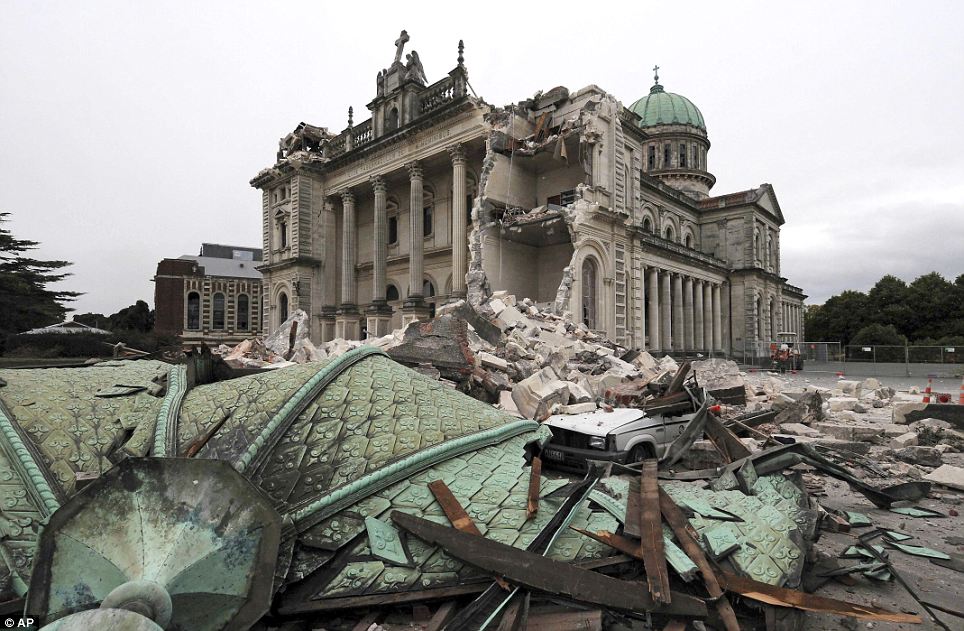
The city's iconic Cathedral of the Blessed Sacrament lost its steeple in the quake which measured 6.3 on the Richter scale
A policeman talks to a woman trapped in a collapsed cathedral
Two women hug each other
A woman talks to a policeman trying to help her from the cathedral while friends hug after their narrow escape in a shopping mall
People walk across a buckled road in Christchurch
A car is seen crushed by debris outsidea home in Christchurch
Rescue workers work to extinguish a fire at a collapsed building of King's Education in Christchurch
Rubble lies strewn in Manchester Street in central Christchurch
A car is crushed by fallen concrete after the earthquake
Oxford Terrace Baptist church is reduced to a pile of bricks
Another church hit was the Christchurch Catholic Cathedral
Another church hit was the Christchurch Catholic Cathedral, which lost a dome
An injured person is carried away after being rescued from a collapsed building
Office workers
A woman is stretchered away after being rescued and a group of office workers unsteady on their feet make their way home from a damaged building
An overheld view of a road with collapsed buildings all through it
An overheld view of a road with collapsed buildings along its entire length
Rescuers climb across rubble to attend to a women found alive in the the collapsed multi level office block on Madras Street
A brave worker is winched out of an office block window to safety to Grabs from footage of the
Streets are seen covered with water after the earthquake
Streets are flooeded after the earthquake burst pipes below the ground and water rose to the surface

Saturday, February 12, 2011

World's best press photographs of 2010

The catapult kid of Bangkok, the Time cover girl mutilated by the Taliban and the world's other best press photographs of 2010

By Mail Foreign Service
Last updated at 7:11 PM on 11th February 2011

At the height of the anti-government protests in Bangkok, with buildings on fire all around and armed with a medieval weapon, a young man bravely fights for what he believes in.
What's more the catapult kid was taking on armed soldiers in a 'live fire zone' declared by the military, which anybody be they protester, resident, tourist or journalist would be shot on sight.
Taking that risk, besides the subject of the photograph, was its taker, Corentin Fohlen, a Frenchman working for Fedephoto, whose skill and bravery won him second prize in the Stories Spot News section of the World Press Photo awards, announced today.
Catapult kid: An anti-government protester uses very basic materials against the authorities in May 2010. Taken by Corentin Fohlen of France, for Fedephoto, it won 2nd Prize Stories Spot News in the 54th annual World Press Photo Contes in Amsterdam
 Jodi Bieber, of South Africa, Institute for Artist Management for Time magazine, for the portrait of Bibi Aisha,
The top prize World Press Photo Of The Year was won by Jodi Bieber, of South Africa, Institute for Artist Management for Time magazine, for the portrait of Bibi Aisha, the 18-year-old Afghan woman whose nose was cut off
The 'Red shirt' protest was organised by the National United Front of Democracy Against Dictatorship (UDD) from March to May against the Democrat Party-led government of r Prime Minister Abhisit Vejjajiva.
More than 80 civilians and six soldiers were killed in the violence before the military successfully cracked down on the protesters on 19 May.
There are stories behind all the pictures, the best - and most shocking - of which are showcased here.

Perhaps the most touching is that behind a South African photographer's portrait of an Afghan woman whose husband sliced off her nose and ears.
Jodi Bieber's picture of Bibi Aisha, 18, who was rescued by the U.S. military and now lives in America awaiting reconstructive surgery won the overall top prized World Press Photo award for 2010.
The posed picture, which contrasts the woman's arresting beauty against the results of the violence done to her after she fled an abusive marriage, was published on the cover of Time magazine on August 1.
Bieber, 44, a winner of eight previous World Press Photo awards since 1998, is a freelance photojournalist affiliated with the Institute for Artist Management/Goodman Gallery. She has published two books on her native South Africa.
Jury members said the photo, though shocking, was chosen because it addresses violence against women with a dignified image.
A man carrying his catch through the streets of Mogadishu, Somalia. This picture, taken by Omar Feisal, Somalia, for Reuters, won 1st Prize Singles Daily Life
Atlantic Sailfish attack Spanish sardines, off Yucatan Peninsula, Mexico, in a picture by photographer Reinhard Dirscherl, Germany, which won 2nd Prize Singles Nature
'This could become one of those pictures - and we have maybe just 10 in our lifetime - where if somebody says 'you know, that picture of a girl' - you know exactly which one they're talking about,' said jury chairman David Burnett of Contact Press.
The picture also gains part of its resonance from its similarity with the iconic 1984 National Geographic photograph of a beautiful young Afghan woman with a piercing gaze.
Time's publication of the picture provoked international debate over the ethics of publishing - or not publishing - such a disturbing image.
The Eritrean national cycling team
The Eritrean national cycling team passes a camel caravan on the road from Barentu to Keren, by Chris Keulen, of the Netherlands, Panos, pictures for Geo, who won 3rd Prize Stories Sports
Whooper Swans at dawn, in Hokkaido, Japan, in a picture taken by Stefano Unterthiner, Italy, for National Geographic magazine, winner of 2nd Prize Stories Nature
Hindu devotees walking towards the ash-shooting Mount Bromo volcano, in Cemoro Lawang, Java, to make offerings in a picture taken by AFP photographer Christophe Archambault
Four Somali refugees
Four Somali refugees en route to Yemen sleep in the desert after traveling all night on muddy roads and in pouring rain, Somaliland, in a picture by Ed Ou, Canada, Reportage by Getty Images, who won 1st Prize Stories Contemporary Issues
'It's a terrific picture, a different picture, a frightening picture,' said Juror Vince Aletti, an American freelance critic. 'It's so much about not just this particular woman, but the state of women in the world.'
In a video commentary on Time's website, Bieber said, 'It was more about capturing something about her - and that was the difficult part.' She said she did not want to portray Aisha as a victim. 'I thought, no, this woman is beautiful.'
Aisha posed for the Time cover photo because she wanted readers to see the potential consequences of a Taliban resurgence, the magazine said when it was published.
Andrew Biraj, a Reuters photographer based in Bangladesh, has won the 3rd Prize Daily Life Single category with this picture of an overcrowded train approaching a station in Dhaka
Taxis waiting at a railway crossing in Calcutta were taken by Martin Roemers, a Panos Pictures photographer based in the Netherlands, winning him 1st Prize Daily Life Stories category
A sister of Feroz Ahmad, alias Showkat, who was killed by forces, wails as she clings to the bed carrying the body of her brother
A sister of Feroz Ahmad, alias Showkat, who was killed by forces, wails as she clings to the bed carrying the body of her brother during his funeral in Pattan, north of Srinagar, India. Altaf Qadri was awarded the 1st prize in the the People in the News singles
In all, 56 photographers of 23 nationalities won prizes. They competed among a record pool of 108,059 photos by 5,847 photographers participating from 125 countries.
Bieber, the overall winner, also won first place in the portraits category for the same photo. She will receive a cash prize of €10,000 in a ceremony later this year.
Two of the more shocking, of a suicide leap in Hugary and of dead bodies in Haiti, are printed further below, so those of a sensitive disposition should perhaps scroll down no further.
Wolfram Hahn, Germany, won 2nd Prize Stories Portraits for the subject of self-portraits for social networks
Nguyen Thi Ly, 9, who suffers from Agent Orange disabilities in Da Nang, Vietnam, was captured by Ed Kashi, USA, VII Photo Agency, won 2nd Prize Singles Contemporary Issues
WARNING: GRAPHIC CONTENT
Olivier Laban-Mattei, France, Agence France-Presse, won 1st Prize Stories General News for this horrific picture of dead bodies at a morgue after the Haiti earthquake
Peter Lakatos, from Hungary, MTI, won 1st Prize Singles Spot News for this picture of a suicide jumper on fire in Budapest